
Laredo City Directory Holdings
Several repositories document historic Laredo directory issues, but their lists are complementary rather than interchangeable. The Texas State Library and Archives Commission catalog lists issues for 1920-21, 1923-24, 1930, 1935, 1964, 1968, 1970, 1972, 1973, 1976, 1981, and 1985. A City historic-preservation bibliography identifies 1900, 1911, 1920-21, 1922-23, 1930, and 1935 at the Laredo Public Library historical collection. The separate lists make it worthwhile to verify both the repository and the particular issue before planning a visit or request.
| Collection | Years located | Where held | Access |
|---|---|---|---|
| Laredo Public Library historical collection | 1900, 1911, 1920-21, 1922-23, 1930, 1935 | Luciano Guajardo Historical Collection | Closed-stack research room; handling and reproduction rules apply |
| Texas State Library catalog holdings | 1920-21, 1923-24, 1930, 1935, 1964, 1968, 1970, 1972, 1973, 1976, 1981, 1985 | Texas State Library and Archives Commission | Catalog-listed holdings; confirm issue and repository |
| Webb County Heritage Foundation directory pointers | 1900 and 1911; a 1930 volume pointer was located | Webb County Heritage Foundation archive shop | Paid reproductions for some items; the 1930 page had an access error during research |
| Regional history and genealogy collections | Regional and archival scope, not a verified directory run | TAMIU SPARC | Reading-room material; use named collections and finding aids |
The State Library catalog page is pictured below because it is the clearest starting point for checking the noncontinuous Laredo issue list.
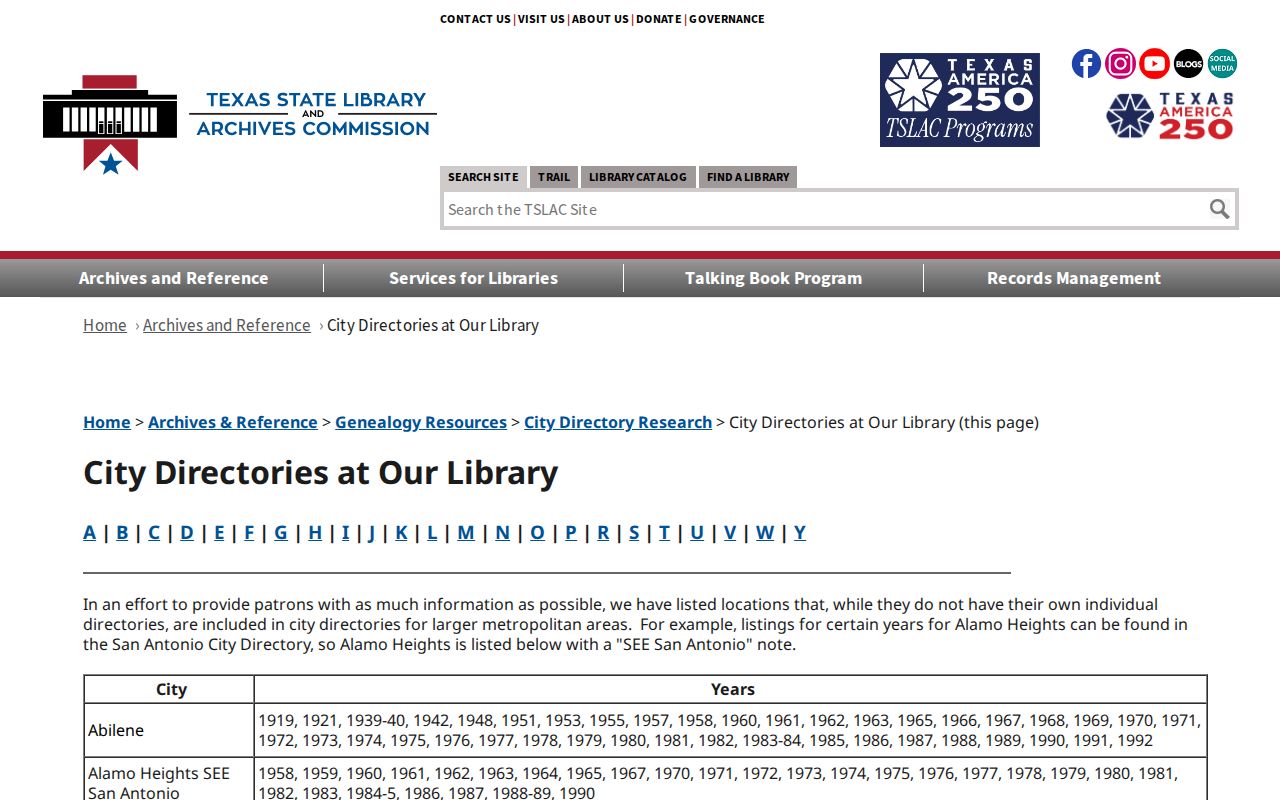
The catalog identifies years, not a complete publisher history or an online scan for every issue. Treat a catalog result as a shelf lead, then confirm the physical or digital item.
Laredo City Directory Research Rules
The Laredo Public Library’s Luciano Guajardo Historical Collection policy places city and telephone directories beside yearbooks, microfilm, newspapers, clippings, maps, photographs, family trees, and local-history material. It is a closed-stack room. Visitors sign a log, may be asked for identification, do not check material out, and follow no-food and no-personal-items handling rules. Reproduction needs permission. These rules matter when a directory entry has to be checked against a title page, an abbreviation key, or a neighboring listing.
The policy also gives several access channels. Staff can assist with local-history material, but they do not conduct original genealogical research for the requester. Mail, fax, and email requests are accepted under the historical-collection policy, while more involved work follows that policy’s research procedures. The library’s Portal to Texas History partner listing identifies contact Renée LaPerrière at 1120 East Calton Road, 956-218-2511, and rlaperrier@ci.laredo.tx.us. A request works best when it names an issue year, surname, street, institution, or collection rather than asking for a broad search of all materials.
Note: A directory’s inclusion in a research collection does not make it a current address source or a complete roll of everyone in Laredo.
Laredo Directory Years Located
The Laredo issue trail has meaningful gaps, so it should be read as a set of dated snapshots. The earliest directory pointers found for this research are 1900 and 1911 at the Webb County Heritage Foundation. The Laredo Public Library bibliography then identifies 1920-21, 1922-23, 1930, and 1935. The State Library’s catalog adds 1923-24 and a later series ending with 1985. Its catalog listing does not name publishers for the individual Laredo issues, which is a useful reason to inspect a surviving title page before crediting a publisher or treating two similarly dated volumes as the same edition.
- 1900 and 1911: Heritage Foundation directory products point to early Laredo volumes.
- 1920-21 through 1935: Library and State Library lists identify several interwar issues, with a 1922-23 and a 1923-24 listing that require issue-level checking.
- 1964 through 1985: The State Library catalog identifies 1964, 1968, 1970, 1972, 1973, 1976, 1981, and 1985.
This timeline does not prove annual publication, a publisher change, or a final printed issue. It records only the years located in the cited repository descriptions. The safest citation includes the issue year, repository, title-page wording, and whether the researcher used an original, copy, catalog entry, or product listing.
Read a Laredo City Directory
A directory entry has to be read as a publication-year record, not as a biography. The Library of Congress city-directory guidance says such volumes can connect a name with an address, business listing, or household context in a particular year. The Laredo research did not capture a full entry from a specific issue, so symbols for ownership, spouse notation, or an occupation field should never be assumed. Check the volume itself, especially its opening pages, before translating an abbreviation or using a mark as evidence.
| Name as printed | Use the spelling and initials in that issue; compare variants across later sources. |
|---|---|
| Address | A dated address or household location may appear, but it is not proof of continuous presence. |
| Business listing | Where present, it can connect a name to a business or institution in the publication year. |
| Household context | Read neighboring words and sections in the same volume before inferring a family relationship. |
| Volume key | Photograph or transcribe the issue’s own abbreviation key when one is supplied. |
- Criss-cross directory
- An address-ordered directory section, used to move from a street listing back to names. The research did not verify a Laredo criss-cross run, so confirm the section in the actual volume.
- Householder index
- An index organized around a household name rather than a street sequence. Its presence and arrangement must be checked in each issue.
- Abbreviation key
- The publisher’s explanation of shortened words or marks, usually placed in the volume’s front matter when included.
Laredo Directories Near San Agustín
Laredo’s historic records gain context when an entry is tied to a public place rather than treated as a profile of a past household. The City’s historical sketch places the 1755 settlement near present-day San Agustín Plaza, and its preservation material describes a Spanish colonial center along the Rio Grande. A date from a directory can be paired with the City history, a marker record, or a map to ask what stood on a central block at that time. It should not be used to claim where a person lives now.
The strongest block history separates each source by date and purpose. A city directory may offer a name or business at a publication-year address. A Sanborn map can show a building footprint, lot arrangement, street index, or labeled public and commercial use. The Library of Congress Laredo Sanborn record documents a July 1900 map with 10 sheets and related 1885, 1889, 1894, 1905, and 1909 editions. Together, they establish a better historical question: what changed on the block between two dated records?
That method reflects Laredo’s cross-border and colonial archive strength without inventing neighborhood lore. Repository, item title, date, and interpretation boundary all belong in the research notes.
Laredo City Directory Research at SPARC
TAMIU Special Collections and Archives Research Center, known as SPARC, adds the regional setting around an address or surname. Located on the second floor of Killam Library at 5201 University Boulevard, it was established in July 1999 as a Regional Historical Resource Depository for Webb, Dimmit, La Salle, Zapata, Zavala, and Maverick counties. Its named collections include the Lupita Ramírez Genealogy Collection, Rose Tarver Treviño Regional History Collection, Jorge González Streets of Laredo material, LareDOS Newspaper, Laredo Yearbook, Map Collection, Republic of the Rio Grande Research Archive, and several family collections.
SPARC’s named-collections page is shown below because it helps a researcher choose a collection title or finding-aid reference before contacting the reading room.
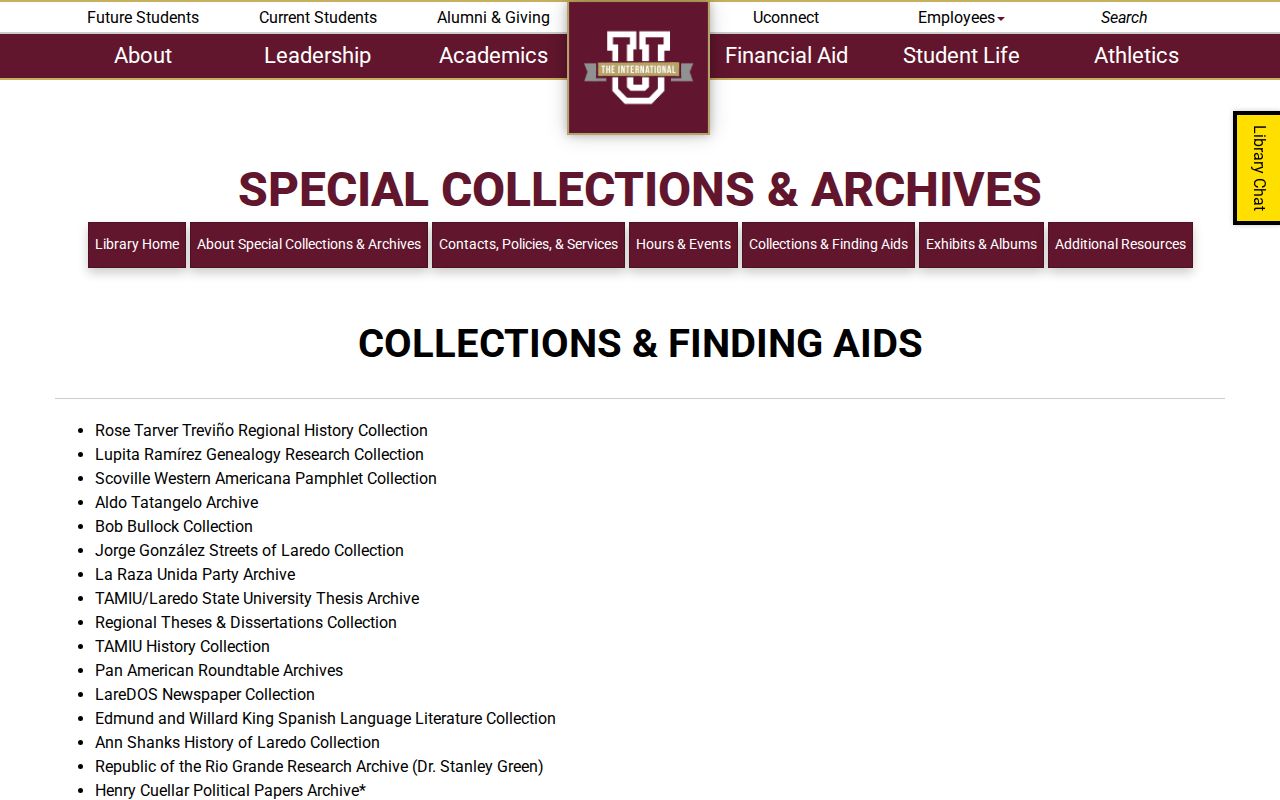
The image supports collection discovery, not a claim that each collection contains a city directory. SPARC holds reading-room material rather than circulating material. Call 956-326-2109 or 956-326-2404, or email jhatcher@tamiu.edu, to confirm hours and the relevant box, folder, surname, event, institution, or street before a visit.
Trace Laredo City Directory Families
Family-history work is clearest when each Laredo city directory issue is only one stop in a dated sequence. Begin with the exact printed name and address, then compare the next available issue rather than assuming an annual run. The federal census offers a separate household snapshot. At the 2026 research date, 1950 census material is open under the National Archives 72-year rule, while 1960 material is expected in 2032. Cite the census year, enumeration geography, and source image alongside the directory date.
- Locate the first available Laredo directory issue that contains the surname, address, business, or household clue.
- Record the issue year, spelling, address, and every nearby qualifier exactly as printed.
- Check the next located issue and note changes without filling the gaps between noncontinuous years.
- Pair the dated listing with the nearest open census snapshot and identify its enumeration geography.
- Use a newspaper, yearbook, family collection, or map only for the separate fact it can support.
A disappearance can reflect a move, a change in publication practice, an omitted listing, a spelling change, or death. It is not a conclusion on its own. When an older directory lead needs a modern records check, the Laredo resident lookup route separates present records from the historical shelf.
Laredo Directory Access Limits
Historical directory access has practical limits. The Laredo Public Library controls materials in its closed-stack room and requires permission for reproduction. SPARC asks researchers to work through reading-room collections and to call ahead because hours may change. The Webb County Heritage Foundation shows some 1900 and 1911 directory products as paid reproductions, while the 1930 product page returned an access error during the research inspection. A missing online image therefore means only that the image was not available through that route at that time.
Digitized Laredo material is also selective. The Laredo Public Library partner collection at the Portal to Texas History includes photographs, maps, border material, and Fort McIntosh-related content. Those items can identify a street, institution, landmark, or neighborhood context, but a caption is not a full resident index. Match the source type to the claim and preserve any reproduction restriction from the repository.
Note: Ask for a named issue or collection, since archive staff can confirm holdings and access rules more reliably than a broad surname request.
Check Laredo Directory Evidence
Good Laredo directory research keeps an evidence trail as careful as the family trail. Record whether the item was an original volume, a paid reproduction, a catalog entry, a map, a finding aid, a digitized image, or a newspaper item. A family tree can be a lead. A census is a dated enumeration. A newspaper notice is an event report. Those distinctions prevent a directory name from becoming more certain than the source allows.
Publisher information is a useful example. The State Library catalog identifies Laredo issue years but does not name a publisher for each one. Compare the catalog listing, the Laredo Public Library collection, the Heritage Foundation pointer, and a surviving title page before recording a publisher, edition, or publication date. This modest check turns an attractive directory lead into a citation that another researcher can find and test.